Eric's work
Cone 9 Crystalline Glazing
Much can be said here & I am in the process of sharing more.
Notable influences who I learned from the most and through the most time: Marvin Bartel PhD Ed. professor emeritus Goshen College, Tom Meuninck (student teaching at Washington HS South Bend, IN, Jeff Unzicker - fellow Goshen College student, Tim Martin brother-in-law, Fred Driver (longtime director of Goshen Clay Artist's Guild ( est 97-98')- Fred & Eric are part of the founding group along with Jerry Lapp MFA, Cindy Cooper MA ceramics & others. Other friends, colleagues, and members of the Goshen potting community who have freely shared information over the years: Mark Goertzen, Dick Lehman, Justin Rothshank. Much credit can also be shared with my high school students who brought a never ending spirit of experimentation to the classroom, notably Trevor Daugherty accomplished potter, writer & CEO of Northern Indiana Clay Alliance, Lee Bolt (Calvin College, MI), Lane Kaufmann, and many others. I've been crystalline glazing porcelain and stoneware for 30 years (as of 2026, longer if you count college).
Even so, I and no living potter can claim to have invented crystalline glazing. Much credit is overdue to Adelaide Alsop Robineau. Ms Robineau lived from 1865 - 1929 and among many collected works of art are her crystalline glazed pieces and her famous 'Scarab vase'. Adelaide pioneered work in crystalline glazing.
THE BEGINNING: Where did I learn crystalline glazing? Much can be credited to Tim Martin, geologist, potter, & explorer who preceded my attendance at Goshen College by 5 years and who married my esteemed sister Elaine. I first took Tim and Elaine to rappel on a cliff and I first threw a pottery piece on Tim's wheel and saw his work in crystalline glazing. Did Tim invent crystalline glazing? Well, like I said, no, none of us living have invented it but I think it's true that we all in some way hope to contribute to the conversation & research. Tim did, with arguably less information and no local expert in crystalline glazing, learn and master his use of recipe(s) from Glazes for special effects and like anyone taking full advantage of studio use under Marvin Bartel, had to learn to fire and repair the kilns. Tim and I both had the benefit of working with Marvin Bartel PhD Ed. Professor Emeritus of Ceramics and Art education at Goshen College. Marvin gave both structure and freedom and often encouraged ownership of one's own learning by replying to questions with something similar to "what do you think?" or "you should Try it and See". True to the 80s and 90s, Marvin was a professorial parent type who gave arguably too much freedom of studio use. We really enjoyed it !!
In addition to Marvin Bartel as our professor, Tim and I had no internet access, cell phones, or even personal computers with searchable content. BUT, the "original text" for us was a Glenn C Nelson textbook and a book in the college library titled "Glazes for Special Effects" with an ENTIRE chapter dedicated to crystalline glazing! Whoah! This gave both of us some structure to start with, a professor who encouraged creativity, scientific engagement, "learning to see a discovery", and as any great ceramic program - a push to learn how to evaluate our firings. Was I exploring crystalline glazing alone? No. Jeff Unzicker (potter) and Chris Kennel, a friend and fellow student and i set out to figure this stuff out before we really even knew how to properly make a glaze. Tim Martin at this time was in Greensboro, NC but available at certain times by the newly available email & a landline phone call. Concurrently Jeff Unzicker and I also began exploring wood firing. Our first firings were in the "Noborigama" wood kiln that Jeff's older brother Tom Unzicker had constructed on their property South of Goshen, possibly with the help of Tim.
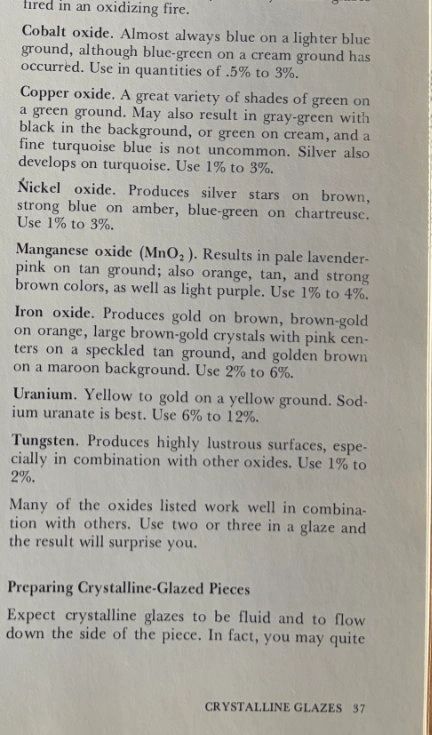
I recently went back to the 'original text' and checked out the chapter. From "Glazes for Special Effects" by Herbert H. Sanders
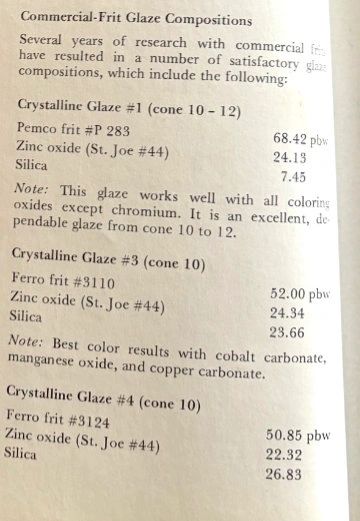
Two portions of pages provide some basic recipes and also basic percentages to follow for coloring oxides and carbonates. I never have used uranium in a glaze and the same goes for me with tungsten although that may change soon regarding tungsten use if it's available.
For years I kept my use of cobalt carbonate to under 1% - possibly a guideline I picked up along the way, I'm not sure why I adopted that limitation but I'm sure we can find instructional basis for it but exceeding 1% has been a lot of recent fun.
From Glazes for Special Effects - Again, I have never used Uranium so i can give no advice here except that I'm generally not interested in working with anything with measurable radiation. Tungsten also, I have interest but have not used it. I provide this snapshot to give context and some general guidelines that I heartily encourage you to moderately exceed.
Some basic crystalline glazing recipes from Glazes for special effects text. For Cone 9 use, start with 50% Ferro Frit 3110, 25% ZnO, 25% Silica, add 3% Bentonite to help with glaze binding and suspension + your favorite color tests. ALWAYS use a mask when mixing raw ceramic chemicals / powders. Use the best possible ventilation - protect your lungs and your skin !
Interstitial Vessels
A reflection on creating interstitial vessels.